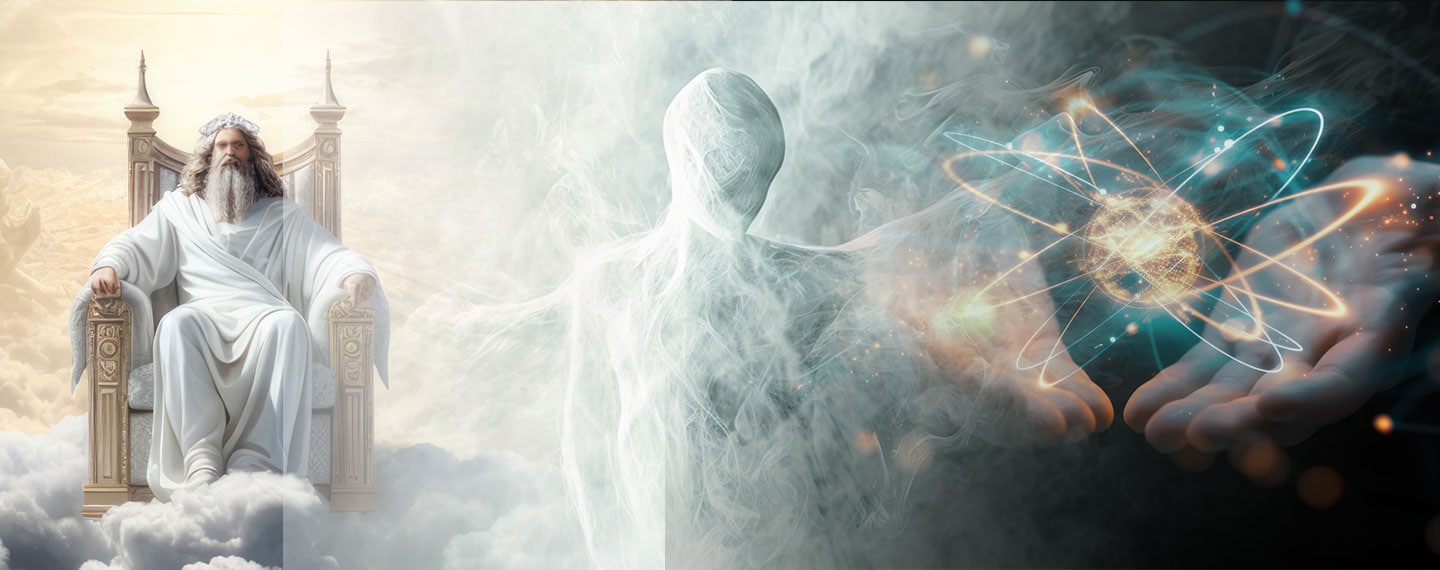
Human beings have always understood the divine through the lens of the world they knew. For most of history, that world felt tribal, hierarchical, mysterious, and often unpredictable. Our gods reflected those conditions.
But today, our understanding of the universe has expanded dramatically. And across multiple fields that rarely speak to one another—cosmology, quantum physics, ecology, psychology, theology, and consciousness studies—a new understanding of reality is being revealed.
Across this spectrum of disciplines, what’s emerging is a reality that is relational, dynamic, interconnected, and still unfolding. It is less a collection of separate things, as we have long assumed, and more a field of interconnection.
As this picture comes into focus, it is quietly reshaping our ideas about the divine. The old metaphors of a god separate from everything else—one who sits above creation and acts upon it from the outside—no longer fit the world we now see. Something new is emerging, something that reflects the deep coherence and creativity woven into the cosmos itself.
(For a deeper look at how earlier cultures shaped their gods to match their worldviews, see The Gods We’ve Made.)
Evolving Theologies: The Divine as Becoming
Some of the clearest voices in this shift come from within Christianity itself—particularly from thinkers who see evolution not as a threat to faith, but as its deepest expression.
Pierre Teilhard de Chardin
Teilhard (1881–1955), a Jesuit priest and paleontologist, believed evolution is not only biological but spiritual. The universe, he argued, is moving toward increasing complexity and consciousness, culminating in the Omega Point—a future fullness of unity and awareness. In this view, the divine is not a static being but the horizon toward which evolution unfolds.
Ilia Delio
Ilia Delio, a Franciscan sister and theologian, builds directly on Teilhard’s work. She describes the divine as the “not‑yet”—a presence emerging through the ongoing evolution of the universe. Drawing on quantum physics, neuroscience, and systems theory, she argues that reality is fundamentally relational, and that the divine is the deep coherence of that relational whole.
Jim Marion and Steve McIntosh
In Death of the Mythic God, Jim Marion argues that humanity is outgrowing the old, mythic image of a supernatural patriarch.
Steve McIntosh extends this idea in Evolution’s Purpose, suggesting that evolution itself has directionality—toward greater depth, consciousness, and value. Both see spirituality as evolving alongside human culture.
Together, these thinkers form a new theological landscape: God is not a distant ruler, but the creative, emergent force of evolution itself.
Cosmology: A Universe Still Coming Into Being
While theology is evolving, cosmology is undergoing its own transformation. The universe is no longer seen as a finished creation but as a 14‑billion‑year-old story that’s still evolving.
Brian Swimme
Swimme, an evolutionary cosmologist, describes the universe as a creative, self‑organizing process. He uses the term “cosmogenesis” to describe it.
In his view, humans are not passive observers but active participants in the universe’s ongoing creativity. This cosmological story aligns naturally with Teilhard’s vision: the universe is not static; it is becoming. And whatever we mean by “the divine” must be understood within that becoming.
Quantum Physics: A Relational Universe
Quantum physics adds to the cosmological picture by revealing a universe in which relationship is fundamental.
David Bohm
Bohm, a noted physicist of the 20th century, and one of the earliest thinkers to explore these implications, proposed that reality has two levels:
- the explicate order, the world as we perceive it
- the implicate order, a deeper, undivided wholeness from which everything unfolds
In Bohm’s view, separation is an illusion. Everything is connected in a continuous, flowing holomovement. Mind and matter are not separate substances but different expressions of the same underlying process.
Bohm’s holomovement can be understood as a kind of dynamic, underlying energy of interconnection, a continuous flow from which all forms arise.
Ecology and Systems Thinking: The Web of Life
Ecology reinforces this same insight.
Fritjof Capra, a physicist and systems theorist best known for The Tao of Physics and The Web of Life, has been one of the leading voices in showing how living systems operate. His work demonstrates that ecosystems are not mechanical structures but networks of relationships—self‑organizing, interdependent, and constantly adapting.
In Capra’s view, life is fundamentally a pattern of dynamic interconnection, not a hierarchy of separate parts.
Thomas Berry, a cultural historian and “geologian,” extends this ecological insight into a cosmological and spiritual framework. Berry argued that the universe is not a collection of objects but a communion of subjects, each participating in a larger unfolding story. His work helped launch the field of “eco‑theology,” emphasizing that the sacred is not above or outside the world but woven into the relationships that sustain life.
Together, Capra and Berry reveal a profound truth: the natural world is a web of relationships, and the divine—if it is to be meaningful today—must be understood within that relational, interconnected fabric.
Consciousness Studies: The Mind Beyond the Brain
Perhaps the most surprising contributions to this emerging picture come from the study of consciousness. The Institute of Noetic Sciences (IONS) and related research communities are exploring consciousness not as a by‑product of the brain, but as a fundamental, non‑local field.
Their research suggests:
- consciousness may extend beyond the individual
- minds may be interconnected
- intention can influence physical systems
- awareness may be a fundamental property of the universe
This aligns with ancient spiritual traditions that see consciousness as universal, not personal. It also supports the idea that the divine is not separate from us—the divine is the field of awareness in which we participate.
Global Spirituality: Beyond the Sky‑God
Outside Christianity, other traditions are also reimagining the divine.
Advaita Vedanta (Hindu Tradition)
Advaita Vedanta, one of the major schools within Hinduism, teaches that the divine is not a sky‑god but Brahman—the infinite, formless ground of being. In this view, the divine is the fundamental energy‑consciousness that permeates and connects all things.
It’s striking that this ancient nondualist understanding of reality emerged thousands of years before modern scientific discoveries, offering one of the earliest visions of the divine as an energy field or universal mind.
Theosophical Society
Founded in the late 19th century, Theosophy blended Eastern and Western ideas, emphasizing universal consciousness, spiritual evolution, and the unity of all life. It helped to seed modern metaphysical and New Age movements.
Unitarian Universalism
UU theology is pluralistic and evolving. Many Unitarians see the divine not as a being but as a symbol of love, justice, or the interconnectedness of life. Their openness to evolving understandings of the divine makes them a natural part of this emerging landscape.
The Dalai Lama
In Beyond Religion, the Dalai Lama argues for a universal ethic grounded not in dogma but in compassion and interdependence. Spirituality, in this view, transcends religious boundaries.
So, What Kind of Divine Is Now Emerging?
When we step back, a coherent picture begins to form.
Across disciplines, the emerging divine is:
- relational, not isolated
- evolving, not static
- immanent, not distant
- cosmic, not tribal
- interconnected, not hierarchical
- a dynamic energy of interconnection, not a personal deity
- the creative unfolding of the universe itself
This is not the divine of ancient myth.
This is not the divine of medieval theology.
This is a divine shaped by our updated understanding of the universe as dynamic, relational, and alive.