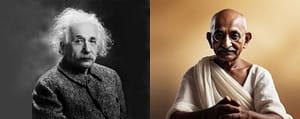


Worlds Apart and Still of Like Mind
Albert Einstein and Mahatma Gandhi emerged from vastly different worlds—one rooted in scientific inquiry, the other within a spiritual arena; one shaped by a Western lens, the other by an Eastern worldview. Yet both dared to reimagine reality, challenge entrenched paradigms, and inspire transformative change. Their methods diverged, but their courage to question, their clarity of vision, and their unwavering commitment to humanity unite them as exemplars of paradigm-shifting leadership.
Albert Einstein
Consider Albert Einstein. His radical rethinking of physics during the first half of the 20th century was initially met with considerable doubt by the scientific community. Still, he pursued a vision of the universe that defied conventional wisdom. Despite the heaps of skepticism thrown at him, he demonstrated resilience and determination in bringing radical new insights, such as the fluid nature of space-time and the interconnectedness of matter and energy, into the mainstream.
Einstein may be most widely known for his contributions to reshaping our understanding of space and time. However, his contributions extended far beyond that, influencing everything from quantum physics to cosmology.
His theory of relativity redefined the concept of gravity, leading to the discovery of black holes and significantly shaping our understanding of the universe’s expansion. His work on the photoelectric effect laid the foundation for quantum mechanics, revolutionizing our understanding of energy and matter at the atomic level. The famous equation E=mc² unlocked the relationship between energy and mass, paving the way for nuclear energy and advanced particle physics. His insights even predicted gravitational waves, which were detected a century later, confirming his profound influence on modern science.
Beyond theoretical breakthroughs, Einstein’s work has countless practical applications. GPS technology uses relativity to maintain accurate time synchronization between satellites and Earth. These discoveries, in turn, contributed to the development of semiconductors, lasers, and modern electronics, which are used in devices such as smartphones, fiber-optic communication systems, and medical imaging equipment.
Mahatma Gandhi
Similarly, also in the first half of the 20th century, Mahatma Gandhi transformed the fight for Indian independence through nonviolent resistance, challenging deeply ingrained beliefs that only armed struggle could dismantle colonial oppression. Despite widespread doubt, his steadfast approach proved that courage and moral clarity could triumph over force.
Gandhi’s impact extends far beyond India’s independence—his philosophy of nonviolent resistance (Satyagraha) reshaped global movements for justice, influencing leaders like Martin Luther King Jr. and Nelson Mandela. His approach was not just about political freedom; it was about redefining power itself—demonstrating through his actions that moral conviction and collective unity could dismantle oppressive systems without resorting to violence.
Beyond his leadership in India’s independence movement, Gandhi championed social reform, advocating for the abolition of untouchability, religious harmony, and economic self-sufficiency through his concept of Swadeshi (self-reliance). He believed that true freedom was not just political but also social and economic, urging people to rethink their dependence on exploitative systems.
His legacy is one of endurance and transformation—despite imprisonment, criticism, and setbacks, he remained unwavering in his belief that change must come from within individuals before it can reshape societies. His methods have been adopted in civil rights movements, environmental activism, and struggles against authoritarian rule worldwide.
Others Who Heard and Acted On the Call
Both Einstein and Gandhi came from modestly privileged backgrounds—neither royalty nor extreme wealth granted them influence. Einstein’s middle-class upbringing provided intellectual stimulation, and Gandhi’s position within a respected family ensured access to education. But their real power came from the force of their ideas—ideas that endured despite initial skepticism and resistance.
However, Einstein and Gandhi are far from being the only individuals who have helped transform the world. Throughout history, countless individuals have emerged who, like Einstein and Gandhi, refused to accept limitations imposed by society. Some gained recognition in their lifetimes, while others worked in obscurity, their contributions only fully appreciated later. What unites them is their resilience—their refusal to let doubt or resistance silence them.
- Copernicus & Galileo revolutionized astronomy, challenging the geocentric model of the universe despite fierce opposition from religious and academic institutions.
- Ada Lovelace envisioned computers before they existed, pioneering concepts that shaped modern computing.
- Frederick Douglass reshaped the abolitionist movement, using his voice to dismantle entrenched racial narratives.
- Marie Curie defied gender norms in science, pushing boundaries that opened doors for generations of researchers.
- Rachel Carson ignited the environmental movement with Silent Spring, proving that awareness could drive large-scale change.
These individuals remind us that visionary thinking is not exclusive to one era or discipline. It’s an ongoing force, constantly shaping our collective understanding. The most profound transformations rarely happen overnight; they occur because people, often in the face of overwhelming doubt, persist.
The lesson is clear: resistance to change is inevitable, but that does not mean progress is impossible.
Building Toward a Tipping Point
History shows that profound change often starts not with widespread movements, but with individuals—those willing to challenge existing paradigms despite resistance. Einstein and Gandhi did not wait for permission or consensus; they saw possibilities that others overlooked and pursued them with conviction.
But their impact did not remain solitary. Over time, their ideas resonated, influencing others who carried them forward, whether through scientific breakthroughs, political movements, or cultural shifts.
Today’s challenges—environmental crises, social inequities, and shifting global dynamics—may seem insurmountable, but change does not begin with the masses. It begins with those willing to rethink, reimagine, and act. The tipping point comes when enough people recognize that visionaries are not anomalies but necessary forces in shaping the future.
Visionary thinking is not reserved for the Einsteins and Gandhi’s of history. It belongs to anyone willing to step beyond conventional limitations and explore transformative possibilities. The question is not whether change is possible, but who among us will choose to lead it?
Albert Einstein’s Contributions
- 7 Ways Einstein Changed the World – A breakdown of Einstein’s most influential scientific contributions.
- Albert Einstein’s Inventions & Contributions – A detailed look at his theories and their impact on modern science.
- 10 Albert Einstein Accomplishments – An overview of his groundbreaking work in physics and beyond.
Mahatma Gandhi’s Legacy
- 10 Contributions of Gandhi That Changed the World – A comprehensive look at his influence on social and political movements.
- Mahatma Gandhi Biography & Achievements – A deep dive into his life, philosophy, and impact.
- 12 Most Important Achievements of Gandhi – A summary of his key contributions to civil rights and independence.
Visionaries Who Changed the World
- 50 Visionaries Who Are Changing Your World – A list of modern thinkers shaping global change.
- Top Visionaries Who Changed the World – A historical perspective on transformative figures.
- People Who Changed the World – A collection of influential figures and their lasting impact.