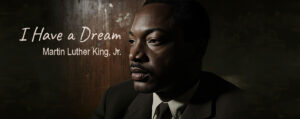


A Voice That Rose Above the Noise
There are moments in history when a single voice rises above the noise of conflict and confusion, offering a vision so clear that it cuts through the divisions of its time. M. L. King, Jr. was such a voice. A Black Baptist preacher from the American South, he became the most recognized leader of the Civil Rights Movement, championing nonviolence as both a moral stance and a practical strategy for social transformation.
In an era marked by segregation, fear, and entrenched inequality, he insisted on something larger — that beneath all the ways we divide ourselves, we belong to one human family.
King’s power did not come from political office or institutional authority. It came from moral clarity — a grounded idealism that refused to accept the world as it was. He saw a deeper truth about human beings, one that many around him could not yet see. And he held to that truth with a steadiness that changed the course of a nation.
An Early Voice for Human Oneness
King often spoke of “the inescapable network of mutuality” and “the single garment of destiny.” These were not just poetic lines. They were statements of worldview — early expressions of an integrated understanding of human interdependence. Long before systems thinking, ecological awareness, or modern neuroscience began describing the interconnected nature of our lives, King was naming it from the steps of churches, community centers, and the Lincoln Memorial.
His idealism was not naïve. It was disciplined. It was courageous. And it was costly.
King faced relentless resistance — from institutions, from political leaders, from those who feared change, and even from within the movement he helped lead. Yet he continued to orient himself toward a larger vision of what humanity could become. His courage was not the absence of fear; it was the refusal to let fear dictate the boundaries of what was possible.
The Dream as a Worldview Statement
That courage reached its most powerful expression on August 28, 1963, when he delivered the speech that would echo across generations. Many people today know only the opening phrase — “I have a dream…” — but the dream itself was vivid, specific, and morally urgent.
He dreamed of a nation where his children would “not be judged by the color of their skin but by the content of their character.”
He dreamed of former slaves and former slave owners sitting together at the table of brotherhood.
He dreamed of justice rolling down “like waters,” and righteousness “like a mighty stream.”
These were not just hopes. They were worldview claims — a declaration that human dignity is universal, that equality is non‑negotiable, and that our divisions are neither natural nor inevitable.
In that moment, King translated a worldview into a vision people could feel. He wasn’t merely describing a better society. He was inviting the nation to imagine itself anew.
For readers who want to listen to the full speech, you can find it here on YouTube: I Have a Dream, Martin Luther King, Jr.
The Cost of Holding a Higher Ideal
King’s life, tragically, was cut short at the age of 39 by an assassin’s bullet. He died because the worldview he embodied threatened the worldview that dominated the culture. But his death did not silence the truth he carried. If anything, it underscored the depth of his commitment and the magnitude of the work still ahead.
In the wake of his assassination, the movement did not collapse. Instead, it widened. Leaders such as John Lewis, Fannie Lou Hamer, Ralph Abernathy, and countless unnamed organizers carried the work forward. King’s message helped catalyze landmark legislation — including the Civil Rights Act and the Voting Rights Act — and inspired global movements for justice, dignity, and human rights. His moral clarity became a touchstone for generations who continued the struggle for equality.
A Legacy That Still Calls to Us
Today, as we navigate our own era of polarization and fracture, King’s message feels as relevant as ever. His moral clarity reminds us that a divided nation is not a fixed condition. It is a challenge — one that calls us to widen our sense of belonging and to recognize the humanity we share.
King’s legacy is not simply a chapter in history. It is an invitation. He showed that even in the face of overwhelming resistance, it is possible to hold a vision of human oneness with enough conviction to move a nation. And he left us with a question that continues to shape our collective journey:
What might become possible if we, too, chose to see ourselves as part of a single human family?