
Long before science offered natural explanations for life’s mysteries, people looked to the sky, the seasons, the storms, and the reality of death to understand why the world behaved as it did. From this impulse emerged the gods—lots of them—all created to help us make sense of an unpredictable world.
Across cultures and eras, these gods took on different names, personalities, and responsibilities. Yet they all served a similar purpose: to give structure to the unknown and to anchor human life in meaning. When we look closely, we begin to see that the gods we inherited were not simply revealed to us. They were shaped by us—by our environments, our social needs, and our evolving understanding of reality.
The Many Gods of the Early Hebrews
The Hebrew tradition is often presented today as the story of a single, eternal, unchanging God. But the historical record paints a more complex picture. Early Israelite tribes did not begin with strict monotheism. They lived in a region where every neighboring culture had its own pantheon, and the Hebrews were no exception.
Archaeology and early biblical texts suggest that different tribes honored different deities:
- El, the high god of the Canaanite pantheon
- Asherah, a mother goddess who appears in early inscriptions alongside Yahweh
- Baal, a storm and fertility god who competed for devotion
- Yahweh, originally a regional warrior deity associated with the southern highlands
Over centuries, as tribes unified and political structures solidified, Yahweh gradually absorbed the roles of the other gods. What began as henotheism—the worship of one god without denying the existence of others—slowly evolved into full monotheism. The transformation was not instantaneous; it unfolded through conflict, reform movements, and reinterpretation of older traditions.
By the time the Hebrew Bible reached its later stages, Yahweh had become not just the god of one people, but the creator of the universe. A once-local deity had expanded into the universal God we recognize today.
The Greek and Roman Gods: Mirrors of Human Nature
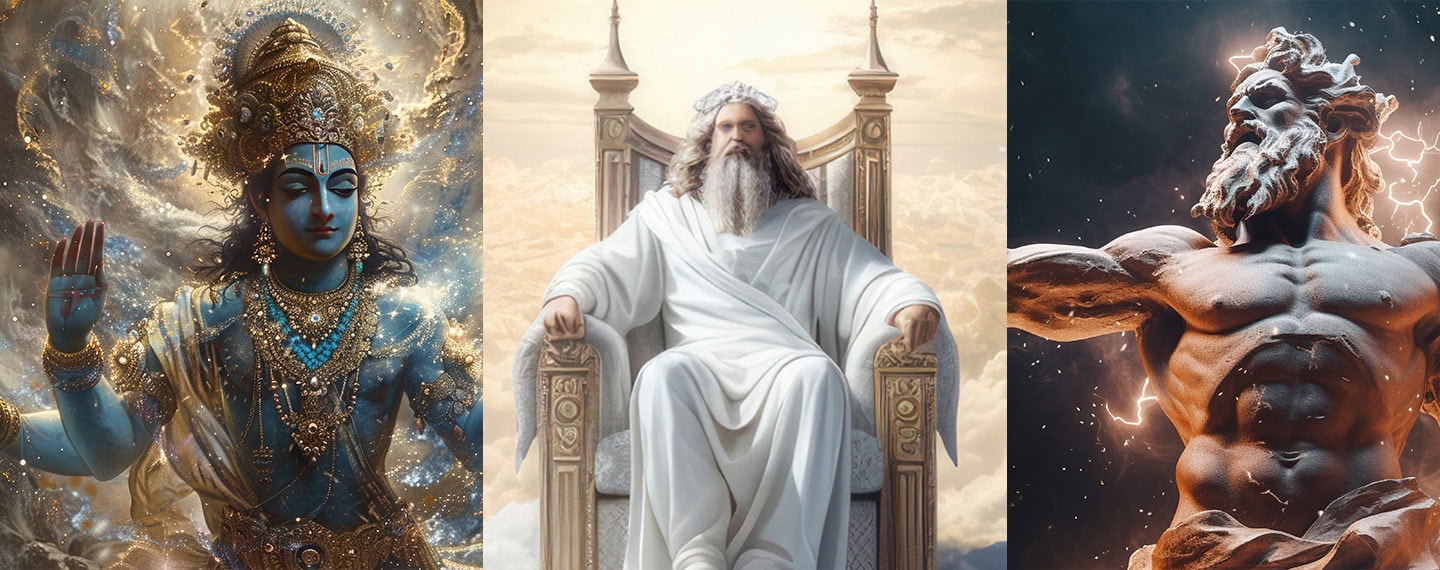
If the Hebrew tradition moved toward unity, the Greeks moved in the opposite direction: they multiplied the divine. Their gods were not distant, perfect beings but exaggerated reflections of human traits—jealousy, ambition, desire, creativity, rage.
- Zeus ruled the sky but struggled with self-control.
- Hera embodied marriage yet was consumed by suspicion and revenge.
- Athena represented wisdom and strategy.
- Ares personified the chaos of war.
These gods were not moral authorities; they were narrative tools. They helped the Greeks explore the complexities of human behavior, the unpredictability of fate, and the tension between reason and passion.
The Romans later adopted these gods, reshaping them to fit their own values. Mars became less a chaotic force and more a disciplined symbol of military virtue. Jupiter became the guarantor of law and order. The gods evolved because the societies that worshipped them evolved.
Egypt: Gods as Cosmic Architecture
Egyptian religion offers yet another model. Here, gods were not primarily human-like personalities but cosmic principles given form.
- Ra represented the sun’s daily journey.
- Osiris embodied death, rebirth, and the agricultural cycle.
- Isis symbolized motherhood, magic, and protection.
- Ma’at was not a deity in the usual sense but the principle of truth, balance, and order.
Egyptian gods were part of a vast symbolic system that explained how the universe held together. Their stories were metaphors for natural cycles, political stability, and the eternal struggle between chaos and harmony.
China and East Asia: Ancestors, Spirits, and the Mandate of Heaven
Did the Chinese “create gods”? Yes—but their approach differed from the mythic pantheons of the Mediterranean.
Early Chinese religion centered on:
Ancestor spirits, who maintained a living connection between generations
Nature spirits, associated with rivers, mountains, and weather
Shangdi and later Tian, abstract sky powers representing order and moral authority
Rather than personal gods with dramatic stories, Chinese traditions emphasized harmony, balance, and the moral responsibilities of rulers. The “Mandate of Heaven” was not a deity but a principle: rulers held power only as long as they governed justly. When they failed, Heaven withdrew its mandate, and rebellion became legitimate.
This was a worldview less about divine personalities and more about cosmic legitimacy and social order.
India: A Tapestry of the Divine
Hindu traditions offer one of the most intricate and philosophically rich explorations of divinity. Rather than a single god or a fixed pantheon, Hinduism presents layers of interpretation:
- Devas such as Indra, Agni, and Varuna appear in early Vedic texts as forces of nature.
- Later traditions elevate Vishnu, Shiva, and Devi as central expressions of the divine.
- Philosophical schools like Advaita Vedanta reinterpret all gods as manifestations of Brahman, the underlying reality of the universe.
Here, gods are not just supernatural beings but symbolic doorways into deeper metaphysical questions. The divine becomes a spectrum—from personal deities to impersonal cosmic consciousness.
Why Humans Create Gods
Across these cultures, a pattern emerges. Gods arise where humans face uncertainty, vulnerability, or wonder. They help us:
- Explain natural forces before science existed
- Establish moral codes and social cohesion
- Legitimize political authority
- Provide comfort in the face of death
- Express awe at the beauty and mystery of existence
- Explore aspects of human psychology through story and symbol
In this sense, gods are not arbitrary inventions. They are cultural technologies—tools for meaning-making.
The God of Christianity: A New Creation or an Inherited One?
Christianity inherited the monotheistic framework of Judaism but reshaped it dramatically. The God of Christianity became more universal, more personal, and more morally absolute. Over time, this God absorbed philosophical ideas from Greek thought, political structures from Rome, and cultural assumptions from Europe.
The result is a deity who feels timeless but is, in many ways, a product of history—shaped by councils, empires, translations, and theological debates.
This raises a provocative but important question:
If earlier gods were shaped by the cultures that worshipped them, why would the Christian God be an exception?
This is not an argument against belief. It is an invitation to examine the possibility that our concept of God—like every worldview before it—reflects the limits and aspirations of the people who carried it forward.
At the Dawn of an Emerging Worldview
As we learn more about the universe—its scale, its age, its complexity—our inherited images of the divine may no longer fit as comfortably as they once did. We may be standing, once again, at the threshold of a new worldview.
Perhaps the question is not whether the gods of the past were “real” or “invented,” but what they reveal about us: our longing for meaning, our need for connection, and our drive to understand the world we inhabit.
And perhaps the next step in our journey is to recognize that the stories we tell about the divine are part of a much larger human project—one that continues to evolve as our understanding of reality deepens.